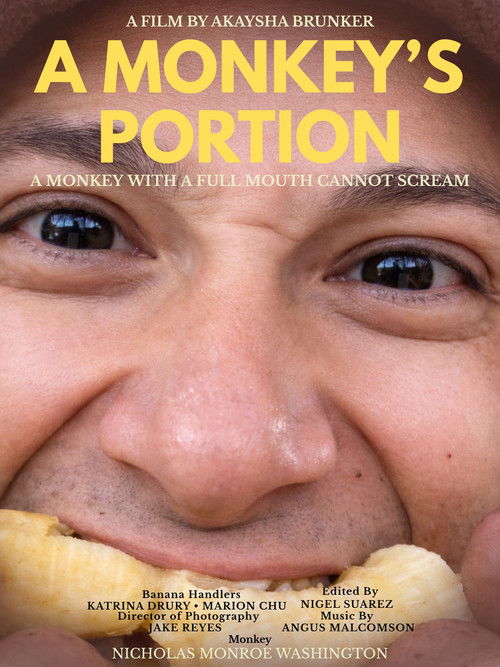
| ⭐ Rating | 0.0/10 | 📅 Year | 2026 |
| ⏱ Runtime | 3m | 🎭 Genre | Horror |
| 🎬 Director | Akaysha Brunker | 🎭 Cast | Nicholas Washington |
Introduction
In the ever-expanding landscape of horror, director Akaysha Brunker’s “A Monkey’s Portion” (2026) is a peculiar and divisive entry. This three-minute short film pushes the boundaries of what can be considered horror, challenging viewers to question the genre’s limits and their own expectations.
Story Overview
“A Monkey’s Portion” is a minimalist horror film that unfolds in a single, unbroken shot. The narrative, if it can be called that, centers around a monkey who films itself eating bananas for an online audience. The monkey’s actions are repetitive, and the film’s brevity leaves little room for traditional plot development. Instead, the horror is derived from the eerie, almost hypnotic nature of the monkey’s relentless consumption, set against the backdrop of a dark, claustrophobic environment. The lack of dialogue and the absence of human interaction only add to the film’s unsettling atmosphere, leaving viewers to interpret the horror in their own way.
Direction & Screenplay
Akaysha Brunker’s direction is both bold and minimalistic. The single, continuous shot adds to the film’s intensity, creating a sense of immediacy and immersion. The camera work is steady and focused, never wavering from the monkey’s face and hands as it methodically consumes the bananas. The screenplay, or rather the concept, is equally daring. By stripping away conventional storytelling elements, Brunker forces the audience to engage with the film on a subconscious level. The lack of dialogue and the minimalist plot serve to heighten the film’s surreal and unsettling qualities. However, the execution is so stark and silent that it may not resonate with everyone, which could be seen as a strength or a weakness depending on one’s perspective.
Performances
The sole focus of the film is the monkey, played by a real primate whose natural behaviors are on display. Nicholas Washington, despite not having any lines or overt actions, brings a sense of unease through his presence. The monkey’s facial expressions and body language are mesmerizing, almost alien in their intensity. The repetitive nature of the monkey’s actions—grasping, peeling, and eating the bananas—becomes deeply disconcerting over the film’s short runtime. The lack of human actors allows the audience to fill in the blanks, projecting their own fears and discomfort onto the screen.
Music & Cinematography
The film’s background score is minimal, consisting of a low, ambient hum that adds to the overall sense of unease. The lack of a more overt musical score is a deliberate choice that enhances the film’s eerie atmosphere. The cinematography is noteworthy for its simplicity and effectiveness. The use of a single, unbroken shot creates a sense of confinement and immediacy, drawing the viewer into the monkey’s world. The dark, shadowy environment contrasts sharply with the bright yellow of the bananas, creating a striking visual tableau that is both hypnotic and repulsive.
Verdict
“A Monkey’s Portion” is a film that defies easy categorization. While it may not appeal to everyone, it is a bold and thought-provoking entry in the horror genre. The film’s minimalist approach and the unsettling nature of the monkey’s actions make it a memorable, if not universally enjoyable, viewing experience. Those with an appreciation for experimental and avant-garde cinema, as well as fans of psychological horror, may find something to appreciate in Brunker’s unique vision. However, for those looking for a more conventional horror film, this might be a pass. Rating: 3/10.